

In the rapidly evolving landscape of Internet of Things (IoT) technology, the ability to efficiently detect anomalies within vast streams of sensor data has become increasingly crucial. Among the various algorithms designed for this purpose, Isolation Forest stands out as a particularly effective and versatile solution. This article explores the application of Isolation Forest in IoT networks, highlighting its principles, advantages, and practical implications.
Understanding Isolation Forest
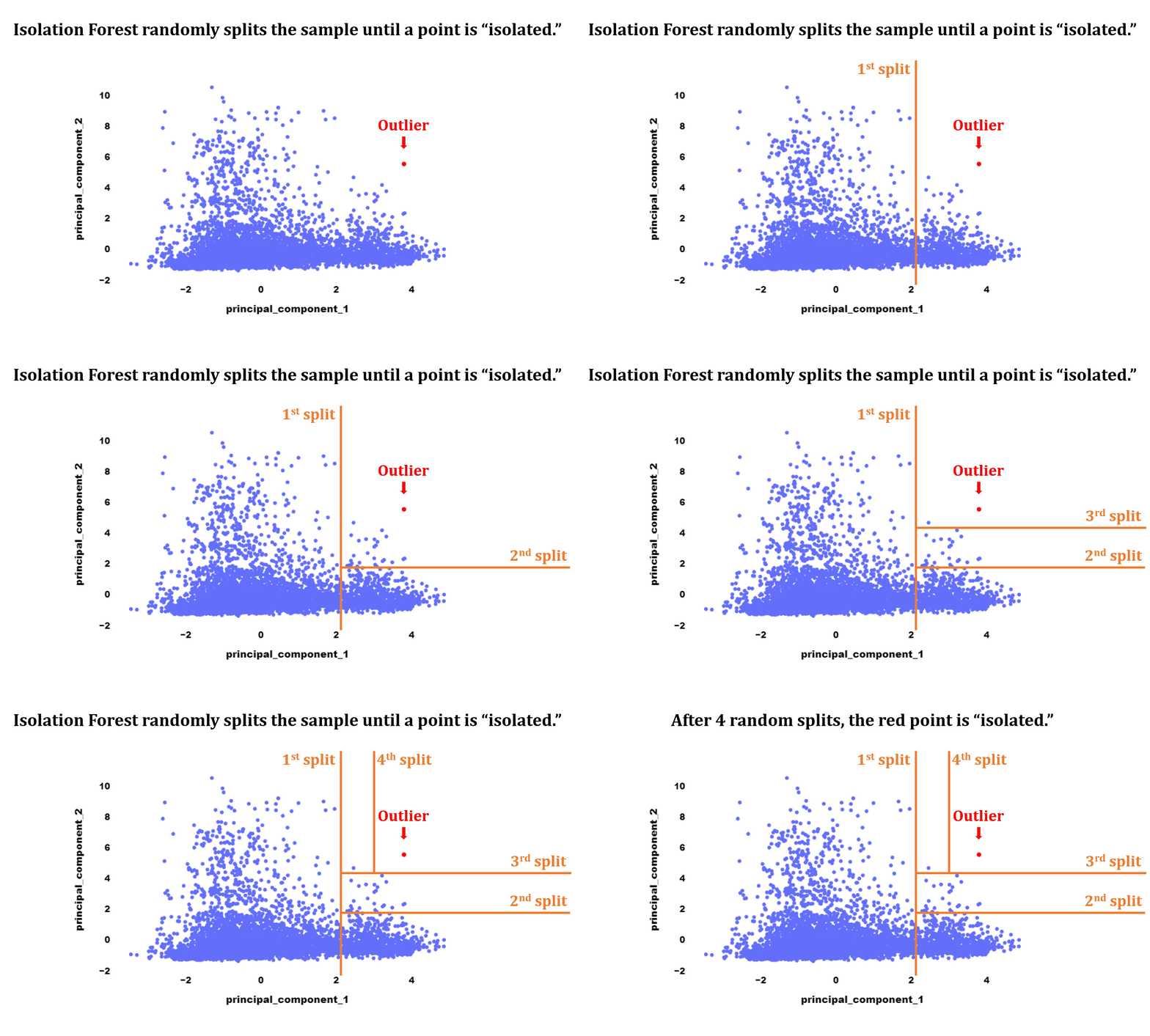
Isolation Forest is an unsupervised machine learning algorithm specifically designed for anomaly detection. Unlike traditional methods that focus on profiling normal behavior, Isolation Forest takes a unique approach by directly isolating anomalies within the dataset. This fundamental difference in methodology contributes to its efficiency and effectiveness, especially when dealing with high-dimensional data typical in IoT environments.
Isolation Forest stands out in anomaly detection through several distinctive features:
- Direct Anomaly Targeting: Unlike algorithms that model normal behavior, Isolation Forest directly isolates anomalies, leveraging the principle that outliers are rare and different.
- Efficiency in High Dimensions: The algorithm maintains effectiveness in high-dimensional spaces, crucial for IoT environments with multiple sensor inputs.
- Unsupervised Learning: No need for labeled data or predefined normal behavior, making it adaptable to diverse and evolving IoT ecosystems.
- Scalability: Efficiently handles large datasets, essential for processing vast amounts of IoT-generated data.
- Intuitive Anomaly Scoring: Provides a nuanced understanding of anomalies beyond binary classification.
key words
Outliers: are data points that significantly differ from other observations in a dataset. In the context of IoT:
- They are observations that fall outside the expected pattern or distribution of data.
- Outliers can represent rare events, measurement errors, or genuine anomalies in system behavior.
- Identifying outliers is crucial for maintaining system integrity and detecting potential issues in IoT networks.
IoT Networks and the Challenges of Anomaly Detection
Understanding IoT Networks
Internet of Things (IoT) networks consist of interconnected devices and sensors that collect and exchange data. These networks can range from small-scale home automation systems to large industrial deployments.
Key characteristics include:
1. Heterogeneity: diverse devices with varying capabilities and protocols
2. Scale: potentially millions of connected devices
3. Dynamic Nature: frequently changing network topology and data patterns
4. Real-time Data Generation: continuous streams of sensor data
Challenges in Anomaly Detection for IoT Networks
1. Data Volume and Velocity:
— IoT networks generate massive amounts of data at high speeds
— Challenge: Processing and analyzing data in real-time without bottlenecks
2. Data Variety and Complexity:
— Multiple data types from diverse sources (e.g., temperature, pressure, location)
— Challenge: Integrating and correlating heterogeneous data for comprehensive analysis
3. Evolving Normal Behavior:
— IoT environments often have shifting baselines of what’s considered “normal”
— Challenge: Adapting anomaly detection models to changing conditions without frequent manual recalibration
4. Resource Constraints:
— Many IoT devices have limited computational power and memory
— Challenge: Implementing efficient anomaly detection algorithms that can run on edge devices
5. Noise and Data Quality Issues:
— Sensor data often contains noise or intermittent errors
— Challenge: Distinguishing between genuine anomalies and data noise or temporary glitches
6. Security and Privacy Concerns:
— IoT networks are vulnerable to cyber attacks, which can manifest as anomalies
— Challenge: Detecting security-related anomalies while preserving data privacy
7. Contextual Anomalies:
— Some anomalies are only detectable when considering the context (e.g., time, location, device state)
— Challenge: Incorporating contextual information into anomaly detection models
8. Scalability of Anomaly Detection:
— As IoT networks grow, anomaly detection systems must scale accordingly
— Challenge: Maintaining detection accuracy and speed as the network expands.
Practical Applications of Isolation Forest in IoT Networks
Mining Industry
In the mining industry, heavy machinery such as drills, excavators, and conveyor belts are crucial to operations. These machines are subjected to harsh conditions and constant use, making regular maintenance essential. However, unexpected equipment failures can lead to costly downtime and even safety hazards. This is where anomaly detection using Isolation Forest becomes invaluable.
Scenario:
- Vibration Monitoring: Vibration sensors are installed on critical machinery to continuously monitor the levels of vibration during operation. Normally, each machine has a specific range of vibration that is considered normal. Deviations from this range might indicate issues like imbalance, wear and tear, or component failure.
Applying Isolation Forest:
- Data Collection: The vibration sensors generate continuous streams of data, capturing the frequency and intensity of vibrations over time.
- Anomaly Detection: Isolation Forest is applied to this data to identify unusual patterns or spikes in vibration levels that deviate from the machine’s typical behavior. Since Isolation Forest excels at isolating outliers, it can quickly detect these anomalies, which are often early signs of mechanical issues.
Triggering Alerts:
- Automated Alerts: When Isolation Forest identifies an anomaly, it triggers an automatic alert that is sent to the maintenance team. This alert could be in the form of an SMS, email, or an update on the central monitoring dashboard.
- Preventive Action: The maintenance team can then inspect the machine before it fails completely, allowing for timely repairs or part replacements. This proactive approach minimizes downtime and reduces the risk of accidents.
Benefits:
- Reduced Downtime: By catching potential failures early, Isolation Forest helps in preventing unexpected breakdowns, ensuring that mining operations continue smoothly.
- Cost Savings: Preventive maintenance is generally less expensive than emergency repairs. Early detection of issues also extends the lifespan of machinery.
- Improved Safety: Detecting anomalies in machinery behavior can prevent accidents that could harm workers, contributing to a safer work environment.
Farming Industry
In the farming industry, maintaining optimal soil conditions is crucial for maximizing crop yield and quality. Soil moisture levels play a significant role in plant growth, and improper watering — either too much or too little — can lead to poor crop health, reduced yields, or even crop failure. Anomaly detection using Isolation Forest can help farmers monitor and maintain ideal soil conditions, ensuring that crops receive the right amount of water at the right time.
Scenario:
- Soil Moisture Monitoring: Sensors are deployed across different fields to measure soil moisture levels. These sensors continuously collect data on moisture content at various depths and locations, providing a detailed view of soil conditions across the farm.
Applying Isolation Forest:
- Data Collection: The soil moisture sensors generate large amounts of data, capturing variations in moisture levels due to factors like irrigation, rainfall, and natural evaporation.
- Anomaly Detection: Isolation Forest is used to analyze this data and identify anomalies, such as sudden drops or spikes in moisture levels that fall outside the expected range. These anomalies might indicate issues like irrigation system failures, leaks, or even unexpected weather changes that could impact crop health.
Triggering Alerts:
- Automated Alerts: When Isolation Forest detects an anomaly, it triggers an alert that is sent to the farmer or farm management system. This alert can be received on a mobile device, allowing the farmer to respond quickly, regardless of their location.
- Responsive Action: The alert might prompt the farmer to check the irrigation system for malfunctions, adjust watering schedules, or take other corrective actions to ensure that soil moisture levels return to optimal conditions. In some cases, the IoT system might automatically adjust the irrigation system to compensate for detected anomalies.
Benefits:
- Optimized Water Usage: By detecting and addressing anomalies in soil moisture levels, Isolation Forest helps ensure that crops receive the precise amount of water needed, avoiding both under- and over-watering. This leads to more efficient water use, which is especially important in regions where water is scarce.
- Enhanced Crop Yields: Maintaining optimal soil moisture levels directly contributes to healthier crops and higher yields. Early detection of potential issues allows for timely interventions that protect crop health.
- Sustainability: Efficient water use and better crop management contribute to more sustainable farming practices, reducing waste and minimizing the environmental impact of agriculture.
Conclusion: Isolation Forest in IoT Anomaly Detection
In this article, we’ve explored the application of Isolation Forest for anomaly detection in IoT networks. We’ve covered:
- The fundamentals of Isolation Forest and its unique approach to anomaly detection
- Key challenges in IoT networks that make anomaly detection complex
- Practical applications of Isolation Forest in the mining and farming industries
Isolation Forest has shown great promise in addressing the specific challenges of IoT environments, offering efficiency in high-dimensional spaces, scalability for large datasets, and adaptability to evolving normal behaviors.
Looking Ahead: Part 2
In the upcoming Part 2 of this series, we will delve deeper into the technical aspects and future directions of Isolation Forest in IoT. Readers can look forward to:
- Technical Implementation: A step-by-step guide on implementing Isolation Forest using popular libraries, with code examples and best practices for IoT contexts.
- Performance Comparison: An in-depth comparison of Isolation Forest with other anomaly detection techniques commonly used in IoT, highlighting strengths and potential limitations.
- Advanced Considerations: Discussion on parameter tuning, handling real-time data streams, and deploying Isolation Forest in resource-constrained IoT devices.
- Emerging Trends: Exploration of cutting-edge developments in IoT anomaly detection, including edge computing implementations and integration with other AI technologies.
- Future Challenges: An analysis of upcoming challenges in IoT anomaly detection and how Isolation Forest might evolve to meet these needs.
Stay tuned for Part 2, where we’ll continue our exploration of this powerful tool in the ever-expanding world of IoT anomaly detection.
In Plain English 🚀
Thank you for being a part of the In Plain English community! Before you go:
- Be sure to clap and follow the writer ️👏️️
- Follow us: X | LinkedIn | YouTube | Discord | Newsletter
- Visit our other platforms: CoFeed | Differ
- More content at PlainEnglish.io
Anomaly Detection in IoT Networks Using Isolation Forest was originally published in Artificial Intelligence in Plain English on Medium, where people are continuing the conversation by highlighting and responding to this story.
* This article was originally published here
