Generative AI (GenAI) is revolutionizing the way we interact with technology, offering unprecedented capabilities in creating content, designing products, and solving complex problems. This article delves into the core aspects of GenAI, exploring its benefits, types, and real-world applications.
What is Generative AI?
Generative AI refers to algorithms and models that can produce new content, such as images, text, music, or even code, from learned data patterns. Unlike traditional AI, which focuses on recognition and classification, GenAI creates novel outputs that mimic the intricacies of human creativity.
Benefits of Generative AI
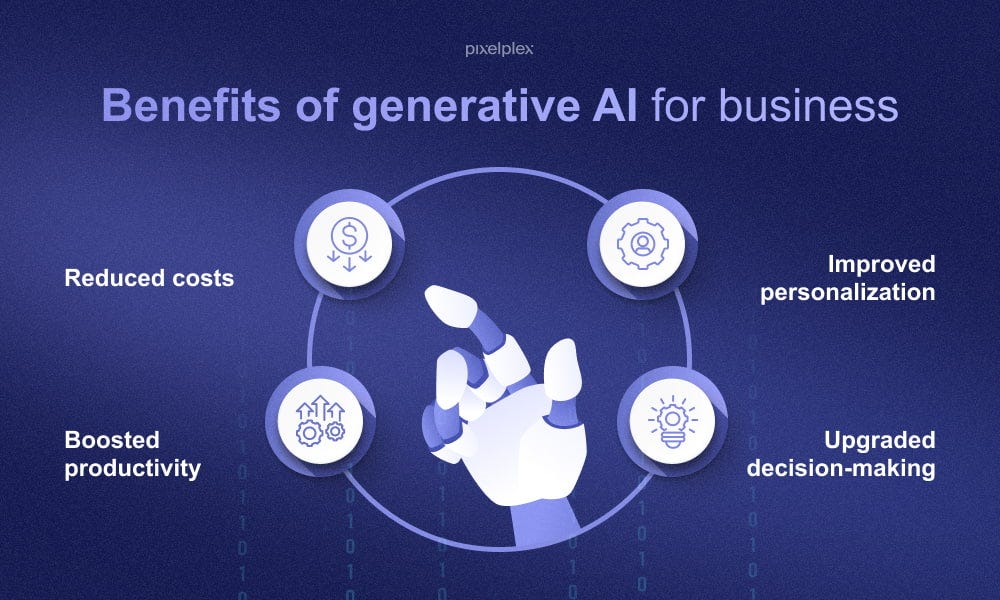
1. Enhanced Creativity and Innovation: GenAI provides tools for artists, designers, and engineers to push the boundaries of creativity. By generating new ideas and concepts, it enables rapid prototyping and exploration of innovative solutions.
2. Efficiency and Cost Reduction: In industries like fashion, architecture, and entertainment, GenAI accelerates the design process, reducing the need for extensive manual effort and thereby lowering costs.
3. Personalization: From marketing to customer service, GenAI allows for highly personalized experiences. It can tailor content, recommendations, and interactions based on individual preferences and behaviors.
4. Data Augmentation: GenAI can generate synthetic data to augment training datasets, improving the performance and robustness of AI models, especially in scenarios with limited or imbalanced data.
5. Problem Solving: In fields like drug discovery and materials science, GenAI aids in exploring vast combinatorial spaces, identifying potential candidates and solutions faster than traditional methods.
Types of Generative AI
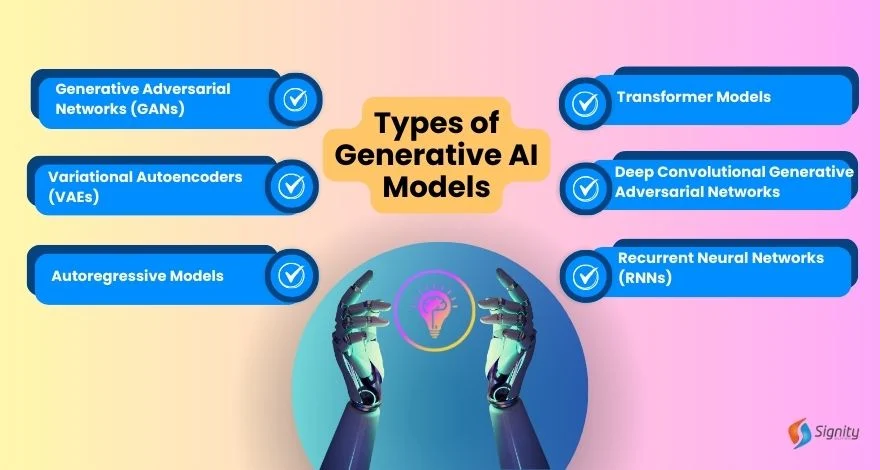
1. Generative Adversarial Networks (GANs):
— How They Work: GANs consist of two neural networks — the generator and the discriminator — engaged in a “game.” The generator creates new data samples, while the discriminator evaluates them against real data. Over time, the generator improves its outputs to fool the discriminator.
— Applications: GANs are used in image synthesis, style transfer, and creating realistic video game characters and environments.
2. Variational Autoencoders (VAEs):
— How They Work: VAEs encode input data into a latent space and then decode it back to reconstruct the data. This process allows for smooth interpolation between different data points in the latent space, facilitating the generation of new samples.
— Applications: VAEs are commonly used for image and text generation, as well as in tasks requiring smooth transitions between different states, like morphing images.
3. Transformers:
— How They Work: Transformers leverage self-attention mechanisms to process input data in parallel, capturing complex dependencies and relationships. They are particularly effective for sequential data like text.
— Applications: The most famous example is OpenAI’s GPT (Generative Pre-trained Transformer) series, used for text generation, translation, and summarization.
4. Recurrent Neural Networks (RNNs):
— How They Work: RNNs process sequential data by maintaining a state that captures previous inputs, making them suitable for time-series and language data.
— Applications: RNNs are used in music composition, text generation, and predictive text input systems.
Real-World Examples of Generative AI
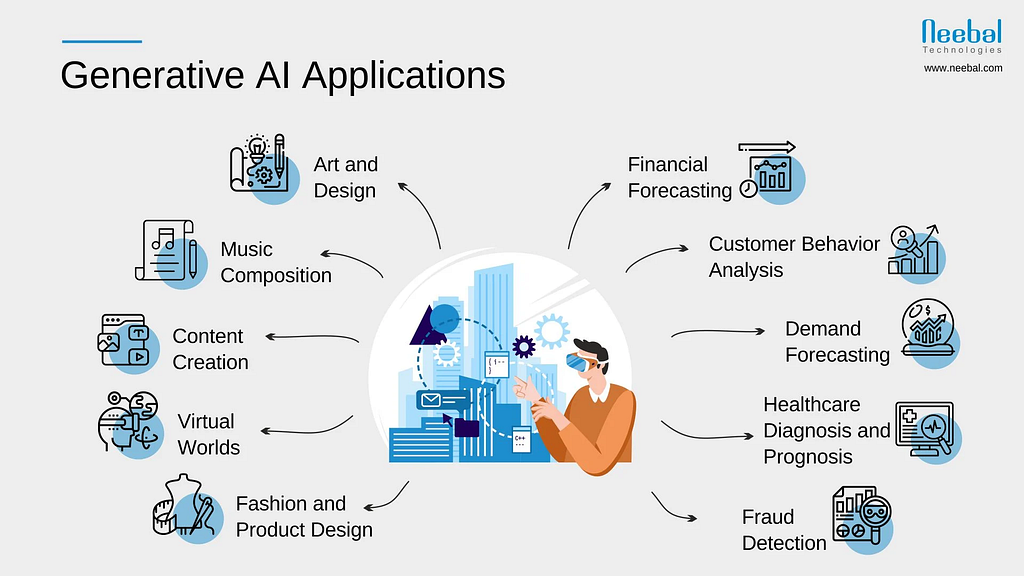
1. Art and Design:
— DALL-E: An AI model by OpenAI that generates images from textual descriptions, allowing for the creation of unique artworks and design concepts based on simple prompts.
— DeepArt.io: Uses GANs to transform photos into paintings in the style of famous artists, enabling new forms of digital art creation.
2. Entertainment:
— JukeBox by OpenAI: A model that generates music in various genres and styles, creating novel compositions and even mimicking the voices of famous singers.
— ScriptBook: Uses AI to generate movie scripts and evaluate the success potential of screenplays, enhancing the content creation process in Hollywood.
3. Healthcare:
— Insilico Medicine: Utilizes GenAI to design new drugs by generating molecular structures and predicting their effectiveness, accelerating the drug discovery process.
— PathAI: Leverages GenAI to assist pathologists in diagnosing diseases by analyzing medical images and suggesting potential diagnoses.
4. Fashion:
— GAN-generated Fashion: Designers use GANs to create new clothing designs, blending different styles and patterns to innovate in the fashion industry.
— Zara’s AI-Powered Designs: Zara employs GenAI to predict fashion trends and design collections based on data from social media and customer preferences.
5. Marketing and Advertising:
— Copy.ai: Uses GPT-3 to generate marketing copy, product descriptions, and social media posts, enabling businesses to quickly create engaging content.
— Persado: Applies AI to generate and optimize marketing messages that resonate with target audiences, increasing engagement and conversion rates.
Challenges and Ethical Considerations
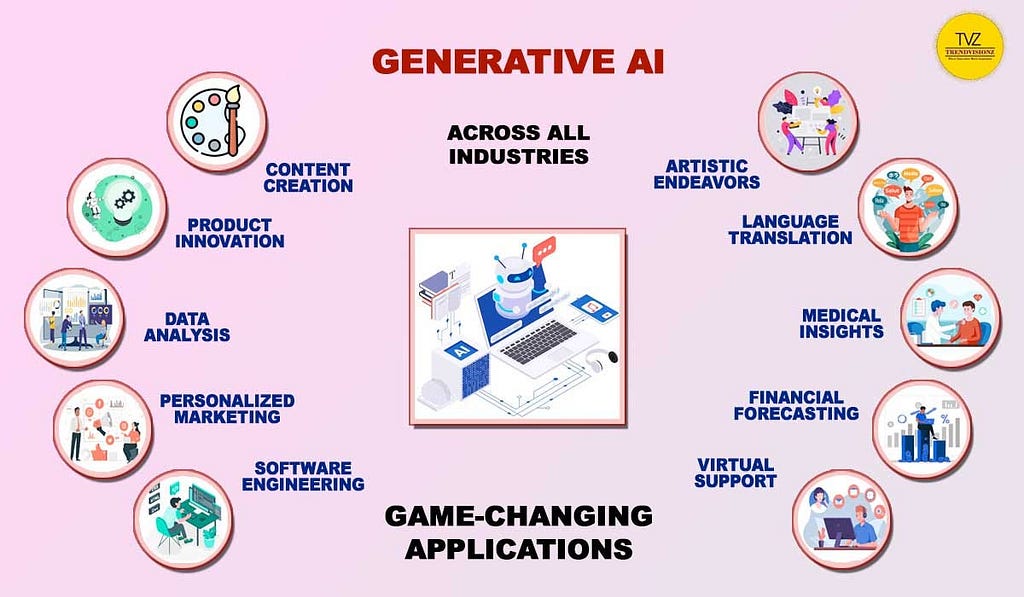
1. Bias and Fairness: GenAI models can inherit biases from training data, leading to biased or unfair outputs. Ensuring diversity and fairness in data is crucial to mitigate these risks.
2. Intellectual Property: The ability of GenAI to create content raises questions about ownership and intellectual property rights, particularly when generated content closely mimics existing works.
3. Misinformation: GenAI’s capability to produce realistic text and images can be exploited to create deepfakes or spread misinformation, necessitating robust detection and countermeasure systems.
4. Ethical Use: As with all powerful technologies, the ethical use of GenAI is paramount. It requires guidelines and regulations to ensure its deployment benefits society and does not harm individuals or communities.
Conclusion
Generative AI is a transformative technology that is reshaping various sectors by enhancing creativity, efficiency, and personalization. Its ability to generate novel content and solve complex problems opens up new horizons for innovation and progress. However, as we harness the potential of GenAI, it is essential to address the accompanying ethical and societal challenges to ensure its benefits are realized responsibly.
Generative AI is not just a glimpse into the future; it is actively shaping the present. From the artwork you see to the music you hear and even the drugs that might one day save lives, GenAI is at the forefront of a technological revolution, heralding a new era of creativity and problem-solving.
Thanks for reading📖! I hope you enjoyed😀 reading this article.
You can subscribe here for regular articles😇.
Let’s connect via GitHub and Linkedin.
Keep smiling😁!
Have a nice day!
In Plain English 🚀
Thank you for being a part of the In Plain English community! Before you go:
- Be sure to clap and follow the writer ️👏️️
- Follow us: X | LinkedIn | YouTube | Discord | Newsletter
- Visit our other platforms: CoFeed | Differ
- More content at PlainEnglish.io
Generative AI: Unveiling the Future of Creativity and Innovation was originally published in Artificial Intelligence in Plain English on Medium, where people are continuing the conversation by highlighting and responding to this story.
* This article was originally published here
